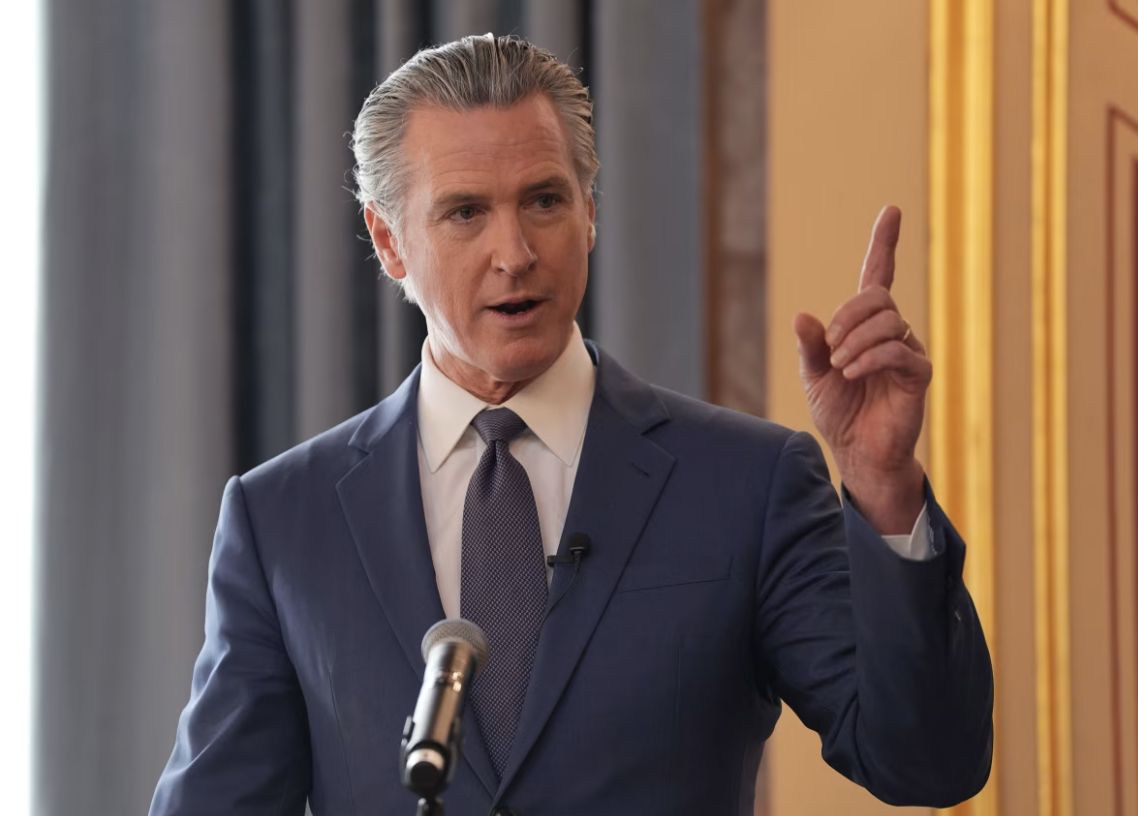
At last week’s Munich Security Conference, Gavin Newsom told the assembled world leaders that “Donald Trump is temporary. He’ll be gone in three years.”
The California governor is right that Mr. Trump won’t be president after Jan. 20, 2029. But the effects of his presidency will remain long after he departs the Oval Office.
The same is true for Mr. Newsom. He’s out as governor next Jan. 4. But the effects of his eight years as California’s chief executive will linger as well.
The difference is that judgments of Mr. Trump’s presidency will be for the history books. The verdict on Mr. Newsom’s record will have immediate, electoral consequences if he tries to succeed Mr. Trump. It will give Mr. Newsom an awful lot to overcome.
Mr. Newsom has the distinction of being the first governor of California since statehood in 1850 to see the state’s congressional delegation shrink, from 53 representatives to 52 after the 2020 census. The state is expected to lose another four to five House seats after the 2030 reapportionment.
Why? Because the Golden State no longer has the quality of life that was long a gigantic magnet for jobs and commerce. The Census Bureau estimates the state’s population actually declined from April 2020 to July 2025.
The U.S. News & World Report’s annual “Best States” ranking puts California at No. 32 on its economy, 42 on fiscal stability, 45 on growth, 46 on employment, and dead last for opportunity.
The Tax Foundation’s 2025 State Tax Competitiveness Index ranked California 48th overall. Only New Jersey and New York have worse tax systems. California was ranked 49th for taxes on individuals, 46th for sales taxes and 41st for corporate taxes.
California’s problems go beyond taxes and a lackluster economy. U.S. News ranked the state 36th in Pre-K-12 education and 43rd on public safety. Only Hawaii has a higher cost of living, according to the World Population Review. Drawing on Bureau of Labor Statistics state-by-state price indexes, the Virtual Capitalist’s average grocery cost index pegged California as the nation’s third most expensive state in July 2025. Only Hawaii and Alaska, whose isolation requires expensive shipping, cost more.
Then there’s housing. Using Redfin data, Forbes found in September that the median California home cost $906,500, nearly twice the national average of $462,206. Only Hawaii and the District of Columbia were more expensive. No wonder California’s population growth has stalled.
If Mr. Newsom does run, his opponents—Democrats in the primary and, if he wins the nominee, the Republican in the general election—will make sure voters know about his stewardship of the Central Valley High-Speed Rail project. After 15 years and nearly $7 billion in federal funding, workers haven’t laid a foot of track.
Mr. Newsom’s only comfort is that he wouldn’t be the only Democratic hopeful with home-state problems to overcome. Under Gov. JB Pritzker, Illinois is, in many ways, also a failing state. In the U.S. News “Best State” rankings, it was No. 35 for opportunity, 42 for the economy and last for long-term fiscal stability.